Table of Contents
- What Drywall Installation Services Near Me Actually Include
- Installation vs. Finishing: Two Different Jobs
- Average Cost to Hang and Finish Drywall: What Drives the Price
- How to Find Reliable Drywall Contractors in Your Area
- Drywall Texture Matching Services: Getting a Seamless Finish
- DIY vs. Hiring Professional Drywall Installation Services Near Me
- Residential vs. Commercial Drywall Projects: Key Differences
- Frequently Asked Questions
Last Updated: September 12, 2026
What Drywall Installation Services Near Me Actually Include
When you search for drywall installation services near me, you are looking for a crew that hangs, tapes, finishes, and textures new wallboard, not just someone who patches a hole. Most homeowners assume these are the same job. They are not, and confusing them is the fastest way to end up with a wavy wall or a ceiling that shows every seam under raking light.
At The Patch Wiz, we have handled everything from single-room renovations to water-damaged ceilings across Levy County, and the pattern is always the same: the visible work is hanging board, but the invisible work, taping, mudding, and texture matching, decides whether the finished wall looks factory-smooth or obviously repaired.
Drywall installation is the process of cutting, fitting, and fastening gypsum board panels to wall or ceiling framing, then taping joints and applying joint compound to create a seamless surface ready for primer and paint. That definition matters because it tells you what you are actually paying for: labor, materials, and the finishing skill that separates a professional result from a DIY patch. Below, we break down what each stage involves, what drives the price, and how to vet a contractor before you hand over a deposit.
Gypsum Association guidance on drywall installation standards
Installation vs. Finishing: Two Different Jobs
Hanging board and finishing it are separate skill sets, and many contractors are strong at one and mediocre at the other. Installation is physical: measuring, cutting panels to fit around outlets and corners, and screwing them into studs or joists. Finishing is where craftsmanship shows. Taping and mudding fills the seams, sanding smooths the compound, and texture matching blends the repair into the surrounding wall.
A common mistake is hiring a crew that hangs fast but rushes the finish coats. Joint compound shrinks as it dries, so skipping coats or sanding too soon leaves ridges that only appear after paint. In practice, the finishing stage often takes longer than the hanging stage, and that is normal.
If a contractor promises a same-day hang-and-finish on a full room, walk away. Proper drying time between coats of joint compound cannot be compressed without visible seams and cracking later.
Average Cost to Hang and Finish Drywall: What Drives the Price
Drywall work is priced by the square foot of wall or ceiling surface, or by the hour plus materials. Pricing depends on quantity, dates, and delivery. For current prices or a quote, please get a free consultation.
A useful way to separate the number is to split it into three buckets:
- Materials, gypsum board, joint tape, joint compound, corner bead, screws, and primer-ready surface prep. Material cost scales with square footage and board thickness.
- Labor, hanging, taping, mudding, sanding, and texture. Labor is usually the larger share of the bill and the part that varies most between crews.
- Overhead and access, scaffolding, dust control, haul-away, and the time lost to occupied homes or tight stairwells.
Here is how the common cost factors actually move the number:
| Cost Factor | Why It Raises the Price |
|---|---|
| Square footage | More board, tape, and compound to install; labor scales roughly with surface area |
| Ceiling height | Anything above 8 feet typically needs scaffolding or stilts and slows every stage |
| Corners and openings | Each outlet, window, and door adds cut-in and finishing work that does not scale linearly |
| Texture matching | Blending orange peel or knockdown takes extra skill and often a second visit |
| Water damage | Removal, drying, and moisture checks add stages before new board goes up |
| Access and cleanup | Tight spaces, stairs, and job site cleanup add hours that never appear on a per-foot estimate |
Why Water Damage and Ceiling Repairs Cost More
Water damage repair costs more than a standard patch because the job is not just cosmetic. The affected board usually has to be cut out, the framing checked for moisture, and the area dried before new board goes up. That drying stage alone can add days to a project that would otherwise be a one-day patch. Ceiling repair adds difficulty because you are working overhead, and texture matching on a ceiling is harder to blend than on a vertical wall, light rakes across a ceiling at a low angle and exposes every imperfect seam.
If you have water stains spreading, treat it as urgent. Mold can begin growing within a day or two of a leak, so fast response matters as much as the repair quality (the EPA). Ask any contractor you call whether they handle the moisture check and drying themselves or sub it out; the answer tells you how much of the job they actually control.
How to Get a Real Number Instead of a Phone Guess
A phone estimate is a guess. The only reliable quote comes after someone walks the space and measures it. When you request that assessment, ask for the quote to be broken into materials, labor, and any access or cleanup charges, so you can see where the money is going and compare bids apples to apples. A contractor who will not itemize is a contractor you cannot compare.
Ask for the quote in writing with the square footage listed. If two bids differ by more than about a third, the lower one is usually leaving out a finishing pass, a texture match, or cleanup, not offering a better deal.
How to Find Reliable Drywall Contractors in Your Area
Finding reliable drywall contractors starts with verifying three things: licensing where required, insurance, and a portfolio of finished work you can actually inspect. Directories list plenty of names, but they rarely tell you who carries liability coverage or who has matched a tricky texture before.
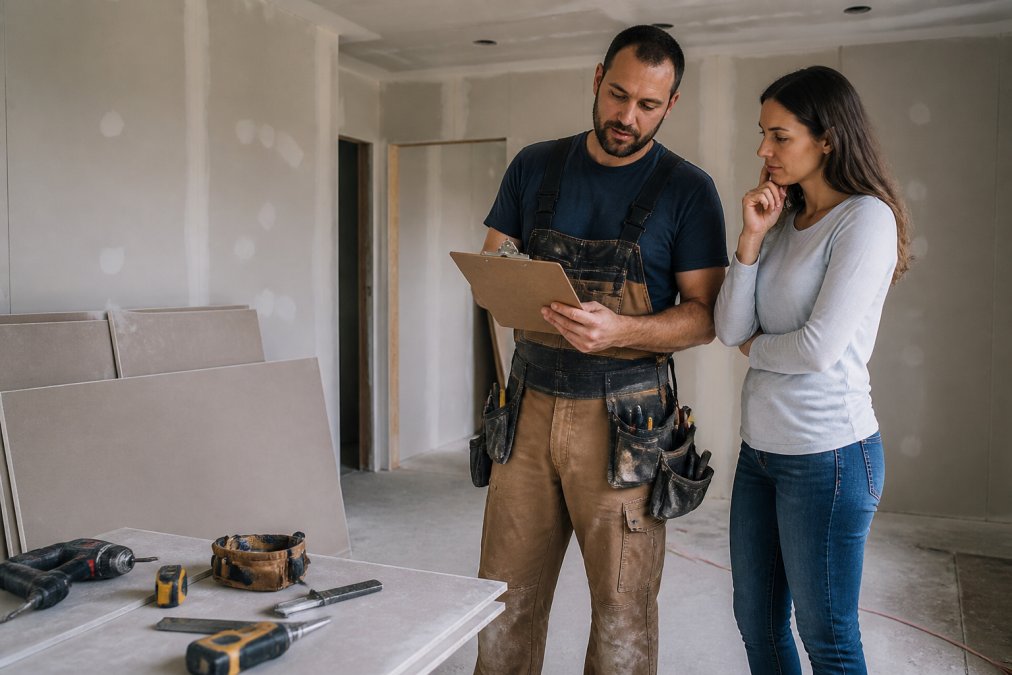
Our advice: skip the directory scroll and start with local pros who can show you completed jobs in your area. Ask for references, and actually call them. A contractor confident in their work will hand over names without hesitation.
Licensing, Insurance, and Questions to Ask
Licensing rules vary by state and municipality, so confirm what your local jurisdiction requires before hiring. Always ask for proof of general liability insurance and workers’ compensation coverage.
Questions worth asking every contractor:
- Are you licensed and insured, and can I see the certificates?
- Can you provide references from jobs similar to mine?
- How do you handle texture matching on existing walls?
- What is your turnaround time, and what causes delays?
- Do you offer a written guarantee if the finish is not right?
- Who handles job site cleanup?
Ask to see a photo of a finished ceiling, not just a wall. Ceilings catch light at a low angle and reveal every imperfect seam, so a contractor who can show clean ceiling work has real finishing skill.
Drywall Texture Matching Services: Getting a Seamless Finish
Drywall texture matching services exist because most homes do not have smooth walls. Orange peel, knockdown, and skip trowel finishes are common, and a patch that is smooth against a textured wall looks worse than the damage did.
Texture matching is the practice of replicating the existing wall or ceiling finish so a repair blends invisibly. It requires matching the compound mix, the application tool, and the technique used on the original surface. Getting it right takes practice, and it is one of the most common places homeowners get burned by low-cost crews.
If your ceiling has that orange peel look and a previous contractor left a flat patch, you already know why this matters. The Patch Wiz specializes in precise texture matching specifically because so many repairs fail at this stage.
DIY vs. Hiring Professional Drywall Installation Services Near Me
DIY drywall is not a binary choice. It is a cost-benefit decision that turns on three variables: the size of the area, whether the surface is textured, and whether the work is overhead. Get those three right and the decision is usually obvious.
The real question is not ‘can I do this?’ but ‘what does it cost me if I get it wrong?’ A failed DIY patch is rarely just the cost of the materials. It is the materials, plus the hours you spent, plus the cost of a professional redoing the work, and the redo is often more expensive than the original job would have been, because the pro now has to remove your compound and re-tape the seam.
Here is how the trade-off actually breaks down:
- Small patch, smooth wall, low visibility (closet, behind furniture): DIY is reasonable. You can accept a slightly visible repair, and the downside if it fails is small.
- Textured wall or ceiling: Hire a pro. Texture matching is a technique problem, not a materials problem. Orange peel and knockdown are applied with specific tools and compound consistency, and hand-matching rarely works on the first try. A flat patch on a textured wall is more noticeable than the original damage.
- Water damage: Hire a pro. Moisture, mold risk, and board removal go beyond cosmetic patching, and a DIY cover-up traps moisture that will reappear as stains or worse.
- Full room or renovation: Hire a pro. Hanging, finishing, and painting a whole space is a multi-stage job with drying time between coats that cannot be compressed.
The Hidden Costs of DIY Drywall
The materials are the cheap part. What DIYers underestimate is the finishing stage. Joint compound shrinks as it dries, so a seam that looks flush when wet can telegraph through paint as a ridge or a shadow. Getting a smooth finish typically takes three coats with drying time between each, plus sanding, and sanding drywall generates fine dust that travels through a house (gypsum.org). Most first-time DIYers spend more on dust containment and rework than they saved on labor.
There is also a tool cost. A proper job needs a taping knife set, a mud pan or hawk, a corner tool, a pole sander, and often a texture hopper or sprayer for matching. Buying those for a single patch rarely pencils out; renting them adds a trip and a deposit.
A Simple Decision Rule
If the repair is smaller than a sheet of board, on a smooth wall, and at eye level or below, DIY is defensible. If any of those three conditions is false, larger than a sheet, textured, or overhead, the math usually favors hiring. The cost of a failed DIY repair is often paying a professional to redo it, plus the materials you already bought. For anything beyond a minor patch, hiring once usually costs less than fixing twice.
DIY drywall pays off only when the downside of a visible repair is low. The moment texture, height, or water is involved, the cost of getting it wrong exceeds the cost of hiring it right.
Residential vs. Commercial Drywall Projects: Key Differences
Residential and commercial drywall projects differ in scale, code requirements, and material selection. Commercial construction often requires fire-rated drywall and specific assemblies that meet building codes, while residential work focuses more on finish quality and texture matching.
Commercial jobs also tend to involve metal studs, higher ceilings, and stricter inspection schedules. Residential remodeling leans on drywall panels, gypsum board, and sheetrock in standard dimensions, with an emphasis on matching the existing interior wall finishing.
Both share the same core sequence: hang, tape, mud, sand, texture, and prep for paint. The difference is in the details, and a contractor experienced in one type is not automatically the right fit for the other.
Match the contractor to the job type. A crew that excels at residential texture matching may not be set up for commercial fire-rated assemblies, and vice versa.
Water damage does not wait, and neither should your repair. The Patch Wiz brings skilled workmanship, quick and reliable project completion, and customized solutions to every job, from urgent ceiling restoration to full-room drywall installation. With 500+ projects completed and a 100% project success rate, our team handles texture matching and water damage restoration so your walls and ceilings look flawless again. Get a free consultation with The Patch Wiz and restore your space with confidence.
Frequently Asked Questions
How much do people charge to install drywall?
Drywall installation pricing depends on square footage, ceiling height, the number of corners and cutouts, whether old material needs removal, and the finish level you want. Water damage or ceiling repairs add labor because of moisture checks and possible insulation replacement. The Patch Wiz provides a free estimate so you get a project quote based on your actual space rather than a generic per-sheet number.
What is the difference between drywall installation and drywall finishing?
Installation covers measuring, cutting, and fastening drywall panels (also called gypsum board, sheetrock, or wallboard) to studs and joists. Finishing is the taping and mudding stage: embedding joint tape, applying joint compound over seams and fastener heads, sanding smooth, and then texturing or leaving a paint-ready surface. Many crews do both, but some only hang panels, so confirm which services are included before you sign off on a quote.
Can you really match the texture on my ceiling?
Yes, texture matching is a core part of professional drywall repair. Orange peel, knockdown, and skip trowel each require a different application technique, tool, and compound thickness. A skilled finisher blends the new patch into the surrounding texture so the repair disappears under paint. Ask any contractor to show examples of texture matching they have completed, and request a test patch on a small area if you are unsure.
How quickly can a drywall contractor respond to water damage?
Response time varies by provider and current workload, but water damage and ceiling stains should be treated as urgent because mold can begin growing within 24 to 48 hours of moisture exposure. When you call, describe the damage and ask for the earliest available assessment. A reliable contractor will inspect for hidden moisture, recommend drying or insulation work if needed, and schedule the drywall repair once the area is confirmed dry.